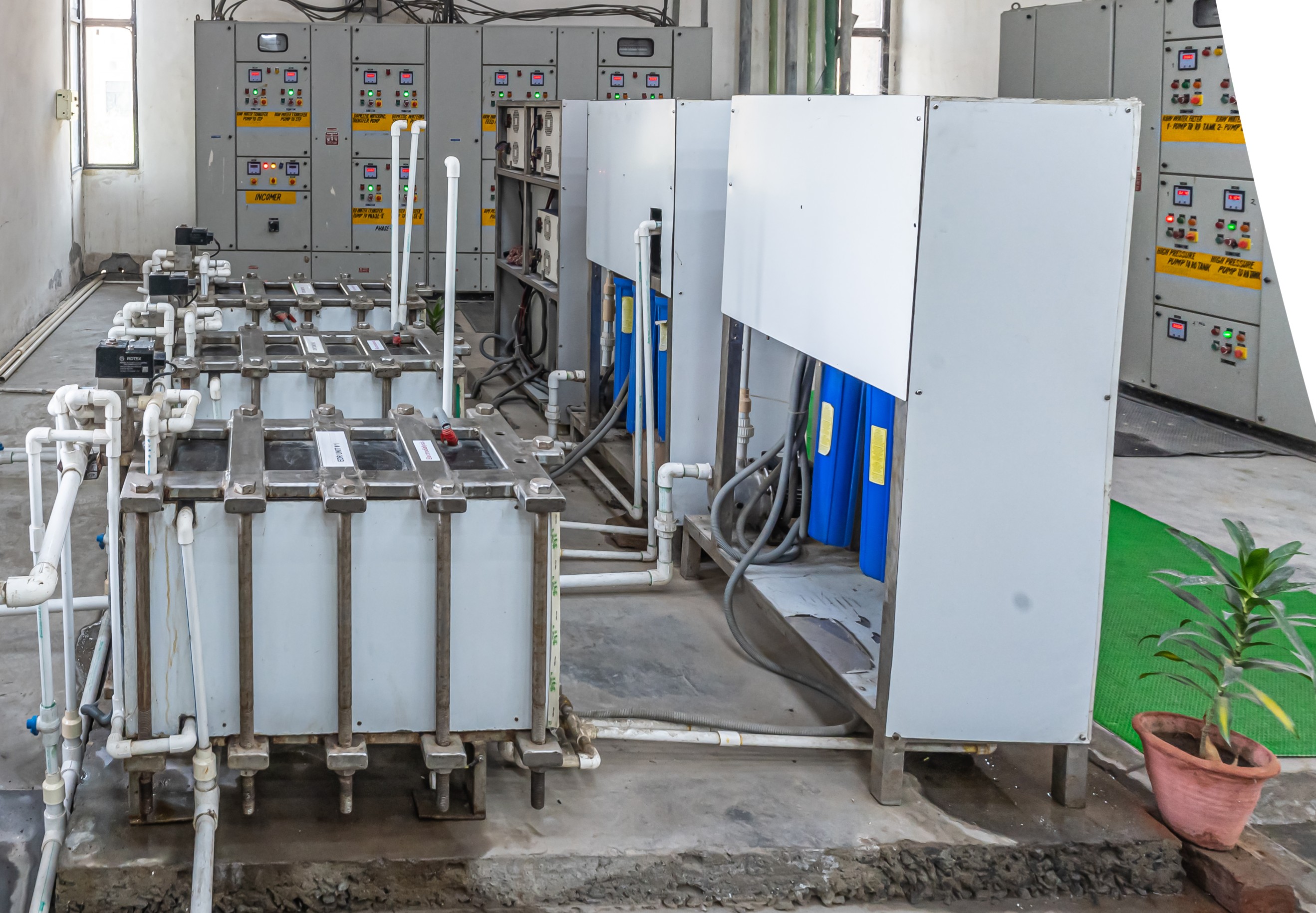

EDR based STP Water Treatment (24 TPD) Plant at NETRA
Brief
NTPC NETRA, in collaboration with CSMCRI Bhavnagar, has setup a 24 TPD Electrodialysis Reversal (EDR) based water treatment plant at the NETRA campus to demonstrate an energy-efficient and sustainable technology for producing high-quality process water with minimal chemical usage and low operational cost.
Electrodialysis (ED) is an electro-membrane process that uses alternating Anion–exchange membrane (AEM) and Cation-exchange membrane (CEM), placed between electrodes.
In electrodialysis, suspended solids which carry positive or negative electrical charges can increase the resistance of the membrane dramatically, are deposited on the membrane surface. This problem has been eliminated to a large extent by reversing in certain time intervals the polarity of the applied electrical potential which results in a removal of charged particles that have been precipitated on the membranes. This technique is referred to as electrodialysis reversal (EDR).
Configuration
- Size of the unit:80 cm X 40 cm each. Total no. of unit = 3
- Number of cell pair of membranes in each unit:120
- Polyethylene based cation and anion exchange membranes
- Output capacity: 1000-1100 LPH
- Feed water TDS = 2000-2500 mg/L, Final TDS= 400-500 mg/L
Salient Strength
- High Yield: High water recovery (>80%) compared to Industrial RO (~60%),
- Low Electricity Consumption: Low power consumption (~2 KWH/M3) compared to RO (~7 kwh/M3),
- Higher Life: Membrane Life (~10 Years) compared to RO (~4 Years),
- Low Water Pre-Treatment: Minimal water pre-treatment requirement compared to RO.
Photo Gallery